2. Literature Review
2.1. Interpreting: The Interpretive Approach
2.1.1. The Interpretive Theory of Translation
Before the interpretive translation theory (the ITT), the prevailing notion regarded translation primarily as a linguistic task aimed at converting one language into another. As esteemed academics and senior conference interpreters, Marianne Lederer and Danica Seleskovitch introduced the ITT in the 1970s, which challenged the prevailing concept and emphasized that the essence of translation lies in conveying the sense of discourse from one language into another. They characterized the process of interpreting as a triangular process encompassing comprehension, deverbalization, and reformulation
. Under this framework, interpreters play a dual communicative role: they first understand the meaning of the speakers and retain the meaning without necessarily retaining the words and expressing the meaning as if they were their own. In this ideal scenario of interpreting, there is no contact between the two languages
| [1] | Lederer, Marianne. 2010. Interpretive approach. In Handbook of Translation Studies, Volume 1, edited by Yves Gambier and Luc van Doorslaer, 173-179. John Benjamins Publishing Company. https://doi.org/10.1075/hts.1.int3 |
[1]
. This explains that an interpreter functions as a conveyor of the sense between the speaker and the listener, highlighting the absence of strictly formal correspondence between the source language and the target language during the interpreting process.
The ITT made a significant contribution by redirecting translation studies away from mere linguistic and contrastive analyses of translation as a product. Instead, the ITT elevated the role of translators to the forefront, placing them center-stage in the study of translation as a cognitive process
| [1] | Lederer, Marianne. 2010. Interpretive approach. In Handbook of Translation Studies, Volume 1, edited by Yves Gambier and Luc van Doorslaer, 173-179. John Benjamins Publishing Company. https://doi.org/10.1075/hts.1.int3 |
[1]
. And the interpretive theory of translation was the first theory of its kind to look into the sense of a contextualized text. In this paper, the researchers adopted the ITT as the theoretical framework and explored the gap between the comprehension of linguistic forms and the sense conveyed by the interpreter.
2.1.2. Comprehension
It is upon the realization that translation offered an interesting vantage point from which one could observe language in action, particularly the process of comprehension, that Seleskovitch and Lederer developed the interpretive theory of translation
| [1] | Lederer, Marianne. 2010. Interpretive approach. In Handbook of Translation Studies, Volume 1, edited by Yves Gambier and Luc van Doorslaer, 173-179. John Benjamins Publishing Company. https://doi.org/10.1075/hts.1.int3 |
[1]
. According to the interpretive theory of translation, human brains do not focus on separate and non-contextual words and then add them together. The theory holds that humans do not understand decontextualized syllables, words, or sentences; rather, by treating language as an act of interaction rather than a sophisticated system, the sense is the result of understanding
| [1] | Lederer, Marianne. 2010. Interpretive approach. In Handbook of Translation Studies, Volume 1, edited by Yves Gambier and Luc van Doorslaer, 173-179. John Benjamins Publishing Company. https://doi.org/10.1075/hts.1.int3 |
[1]
.
2.1.3. Sense and Sense Unit
Sense is a conscious mental representation not to be mistakenly identified with specific linguistic meanings of any given language
| [7] | Seleskovitch, Danica. 1992. “Fundamentals of the Interpretive Theory of Translation.” In Expanding Horizons, Proceedings of the Twelfth National Convention of the Registry of Interpreters for the Deaf, edited by Jean Plant-Moeller, 1-13. Silver Spring, MD: RID. |
[7]
, nor should the sense of a discourse be mistaken with a high degree of uncertainty
| [1] | Lederer, Marianne. 2010. Interpretive approach. In Handbook of Translation Studies, Volume 1, edited by Yves Gambier and Luc van Doorslaer, 173-179. John Benjamins Publishing Company. https://doi.org/10.1075/hts.1.int3 |
[1]
. It comprises linguistic meanings supplemented by pertinent extra-linguistic knowledge provided by hearers/readers, and the shared understanding of the message among interlocutors significantly overlaps, facilitating well-established communication.
| [1] | Lederer, Marianne. 2010. Interpretive approach. In Handbook of Translation Studies, Volume 1, edited by Yves Gambier and Luc van Doorslaer, 173-179. John Benjamins Publishing Company. https://doi.org/10.1075/hts.1.int3 |
[1]
. Interpreting practitioners hold that contextualized words usually have one and only one meaning
. As explained above, there is a distinction between language as a system and language in use. Polysemy and ambiguity only arise in language as a system, not in language in use, where there are specific communicators
| [8] | Seleskovitch, Danica. 1975. Langage, langues et mémoire - Étude de la prise de notes en interprétation consécutive. Paris: Minard Lettres Modernes. |
[8]
.
Sense is non-lingual; it originates from words and is the combination of words instead of the aggregation of their literal meaning. Seleskovitch and Lederer
| [9] | Seleskovitch, Danica, and Marianne Lederer. 1984. Interpréter pour traduire. Paris: Didier. |
[9]
, in line with their interpretive theory of translation, define the translation unit as a sense unit extracted from a segment of discourse, typically comprising a small number of words. These translation units play a crucial role in constructing the deverbalized sense of the entire message to be re-expressed in the target language. Consequently, the length of a sense unit does not necessarily correspond to the length of its linguistic form. In other words, texts of varying lengths may contain the same sense unit, provided they convey an equivalent message between communicators.
As mentioned earlier, according to the ITT, the terms “sense unit” and “translation unit” refer to the same concept
| [9] | Seleskovitch, Danica, and Marianne Lederer. 1984. Interpréter pour traduire. Paris: Didier. |
[9]
. Nevertheless, as products of deverbalization, sense units are derived from the source text rather than directly segmented from it. Thus, there remains ample room for further exploration into how the source text is segmented into translation units and deverbalized into sense units, allowing for a deeper examination of how interpreters analyze the source text and engage in the process of comprehension. The subsequent section will delve into exploring the relationship between translation units and sense units.
2.2. Translation Units Vs. Sense Units
2.2.1. Translation Units
Throughout history, even predating the formal establishment of the terminology of translation units, professional translators have intuitively operated within the framework of translation units when assessing or describing their work. This approach has proven to be equally essential and beneficial for theoreticians seeking to analyze the work of translators. Vinay and Darbelnet
| [2] | Vinay, Jean-Paul, & Darbelnet, Jean. 1995. Comparative Stylistics of French and English: A Methodology for Translation, translated and edited by Juan C. Sager and M. J. Hamel. Amsterdam/Philadelphia: John Benjamins. https://doi.org/10.1075/btl.11 |
[2]
were the scholars who initially proposed the definition of translation units, “the smallest segment of the utterance whose signs are linked in such a way that they should not be translated individually”. Such a segment may not be translated literally, as it represents “a combination of a ‘lexicological unit’ and a ‘unit of thought’”
| [2] | Vinay, Jean-Paul, & Darbelnet, Jean. 1995. Comparative Stylistics of French and English: A Methodology for Translation, translated and edited by Juan C. Sager and M. J. Hamel. Amsterdam/Philadelphia: John Benjamins. https://doi.org/10.1075/btl.11 |
[2]
. Regarding the segmentation of sentences in the source text, translation units can encompass individual words, grammatically and semantically linked groups, fixed expressions, as well as more extended groupings
| [2] | Vinay, Jean-Paul, & Darbelnet, Jean. 1995. Comparative Stylistics of French and English: A Methodology for Translation, translated and edited by Juan C. Sager and M. J. Hamel. Amsterdam/Philadelphia: John Benjamins. https://doi.org/10.1075/btl.11 |
[2]
. Russian linguist Barkhudarov expanded upon the concept of a unit of translation, defining it as the smallest segmentation in the source text with an equivalent segmentation in the target text, with individual parts of the translation unit being untranslatable
| [3] | Barkhudarov, Leonid Stepanovich. 1975. Language and Translation. Moscow: International relations PH. |
[3]
. According to Barkhudarov, the range of forms for a translation unit was broadened, encompassing segments as small as phonemes, morphemes, and individual words, to as large as sentence groups and even the entire source text
| [3] | Barkhudarov, Leonid Stepanovich. 1975. Language and Translation. Moscow: International relations PH. |
[3]
. Contrary to Barkhudarov’s expansive view, Newmark
| [5] | Newmark, Peter. 1981. Approaches to Translation. Oxford & New York: Pergamon. |
[5]
proposed that translation units are limited to words only. Catford
| [4] | Catford, John Cunnison. 1965. A Linguistic Theory of Translation. London: Oxford University Press. |
[4]
emphasized that translation units in the source text may sometimes exist at different linguistic levels compared to their equivalents in the target text, and Koller
| [10] | Koller, Werner. 1992. Einführung in die Übersetzungswissenschaft (Introduction to Translation Studies). Heidelberg: Quelle & Meyer. |
[10]
asserted that the size of translation units is directly influenced by the characteristics of both the source language and the target language, the greater the divergence or lack of similarity between the two languages, the larger the size of translation units.
2.2.2. The Adoption of Translation Units in Interpreting Studies
As the overlap between translation and interpreting makes it impossible to distinguish the two, researchers of interpreting studies are also under the influence of linguistic perspectives
| [11] | Gile, Daniel. 2004. “Translation Research versus Interpreting Research: Kinship, Differences and Prospects for Partnership.” In Translation Research and Interpreting Research: Traditions, Gaps and Synergies, edited by Christina Schäffner, 10-34. https://doi.org/10.21832/9781853597350-003 |
[11]
, and the concept of translation units has been applied to interpreting studies as the field gained rapid progress in the second half of the last century. Interpreting is described as an improvised bilingual oral transformation characterized by temporal closeness and spatial openness
. According to Zhao
| [13] | Zhao, Junfeng. 2005. Lun Kouyi de Fanyi Danwei [Translation Units of Interpreting]. Zhongguo keji fanyi 18(02): 25-27. |
[13]
, the linguistic levels and sizes of translation units in interpreting depend on specific contexts, displaying strong flexibility and dynamics. Considering the spatial and temporal features of interpreting, it is essential to recognize that interpreting is a highly dynamic process, and therefore, the study of translation units should be approached with full consideration of this dynamism in order to segment translation units more flexibly
| [13] | Zhao, Junfeng. 2005. Lun Kouyi de Fanyi Danwei [Translation Units of Interpreting]. Zhongguo keji fanyi 18(02): 25-27. |
[13]
. Cai
| [14] | Cai, Xiaohong. 2003. Lun Kouyi Zhiliang Pinggu de Xinxi Danwei [Sense Units of Interpreting Quality Assessment]. Waiguoyu (05): 75-80. |
[14]
suggests that larger translation units enable interpreters to quickly grasp the main idea of the discourse and provide greater flexibility in restructuring sentences and the overall discourse.
In general, scholars and practitioners widely accept that in interpreting practices, translation units span linguistic levels from words, phrases, and sentences to sentence groups. To enhance the study of the comprehension process and accommodate the flexibility inherent in interpreting, we also included subordinate clauses as translation units. This finer-grained perspective allows for a deeper understanding of how interpreters employ interpreting strategies through the segmentation of translation units.
2.2.3. The Relationship Between Translation Units and Sense Units
Based on the above discussions of sense units and translation units, it is important to distinguish between the two concepts: sense units are deverbalized products of translation units. As a result of understanding, sense units are non-linguistic entities, though Gile
| [15] | Gile, Daniel. 2009. Basic Concepts and Models for Interpreter and Translator Training. Amsterdam: John Benjamins Publishing Company. https://doi.org/10.1075/btl.8 |
[15]
named them
meaning hypotheses. Translation units encompass a variety of linguistic forms, including words, phrases, sentences, and sentence groups. Under the framework of the ITT, studying the impact of segmenting a text into translation units on interpreting quality can provide valuable insights into how interpreters deverbalize these units into sense units and navigate the interpreting process, which typically involves comprehension, deverbalization, and reformulation. By understanding how different segmentation strategies influence interpreting quality, we can develop recommendations for improving interpretation quality.
Limited research has been conducted on the utilization of translation units in the context of consecutive interpreting from an empirical perspective, with even fewer studies referring to the relationship between translation units and sense units. Discussions on the uncertainty of translation units in consecutive interpreting have been raised, highlighting the flexibility and subjectivity inherent in the linguistic forms of translation units
| [16] | Du, Ying. 2008. “A Study on the Uncertainty of Translation Units in Interpreting.” PhD diss., Sichuan University. |
[16]
. However, Du
| [16] | Du, Ying. 2008. “A Study on the Uncertainty of Translation Units in Interpreting.” PhD diss., Sichuan University. |
[16]
failed to differentiate between sense units, a concept under the framework of the interpretive theory of translation, and translation units, a linguistic concept, erroneously treating them as synonymous.
In addition, Lederer herself was among the scholars in interpreting and translation studies who staunchly advocated for the emancipation of translation from the dominance of linguistics
| [17] | Fawcett, Peter. 2007. Translation and Language: Linguistic Theories Explained. Beijing: Foreign Language Teaching and Research Press. |
[17]
. She endorsed an approach to translation that transcends linguistic considerations, asserting the necessity of dealing with translation “on a level other than the linguistic”
| [18] | Lederer, Marianne. 1994. La traduction aujourd'hui. Paris: Hachette. |
[18]
. Yet this research serves as evidence that the pursuit of studying interpreting beyond the superficial aspects of language and textual structure relies on tools developed within the domain of linguistics. It functions as a bridge, connecting the rigid theoretical framework of linguistics with the flexible and contextually nuanced interpretive theory of translation.
3. Methodology
3.1. The Speech
A video clip featuring a speech on addressing climate change delivered by Leonardo DiCaprio at the United Nations, lasting 3 minutes and 47 seconds, was selected as the material for the test. Before the test administration, a readability test was conducted using the toolkit “Textstat.flesch_reading_ease(text)”
, within the range of 0 to 100; the higher the score, the more readable a text is, resulting in an average readability score of 62.65. The coefficient of variation was calculated at 0.49. The test outcomes indicated that the speech demonstrated a moderate level of readability, and the distribution of readability across sentences in the speech exhibited a moderate level of dispersion. The speech, characterized by intermediate readability and an appropriate degree of understanding difficulty dispersion, was deemed suitable for the test.
3.2. Participants
The participants were fourteen student interpreters. All participants had received interpreting qualifications before the test. The participants were all interpreter trainees who came from the UIBE conference interpreting training program. They had taken three semesters of interpreting skills courses, and all obtained a Level 2 CATTI interpreting certificate to ensure their proficiency was roughly in the same range. Before participating in the formal experiment, all participants underwent a one-minute trial interpretation. The method in which the spokesperson’s audio was played, and the way of collecting the interpreters’ performance, were identical, ensuring that the interpreters adapted to the experimental environment.
3.3. Interpreting Quality Measurement
Scholars hold that interpreting features duality as both a text-production activity and a service to enable communication
| [20] | Viezzi, Marina. 1996. Aspetti della qualità in interpretazione. Trieste: Università Degli Studi, Scuola Superiore di Lingue Moderne per Interpreti e Traduttori. |
[20]
. The task of the interpreter ranges from text processing, fulfilling a communicative aim to facilitating communicative interaction, which determines the core criteria of interpretation quality assessment, including accuracy, clarity or fidelity, and stylistic correctness
.
The quality of interpreting is assessed mainly from two perspectives, the product-oriented perspective and the listener-oriented perspective
. The former aims to present a target text or the interpretation as a ‘faithful image’ or an ‘exact and faithful reproduction’ of the original discourse, and the latter aims to reproduce the style of the original discourse
| [21] | Gile, Daniel. 1991. “A Communicative-Oriented Analysis of Quality in Nonliterary Translation and Interpretation.” In Translation: Theory and Practice, Tension and Interdependence, edited by Mary Louise Larson, New York: Routledge. https://doi.org/10.1075/ata.v.19gil |
| [22] | Jones, Roderick. 1998. Conference Interpreting Explained. Manchester: St. Jerome Publishing. |
[21, 22]
. In addition to the tasks mentioned above, the interpreter is also expected to fully represent the intentions and interests of the speaker and the speaker per se
| [21] | Gile, Daniel. 1991. “A Communicative-Oriented Analysis of Quality in Nonliterary Translation and Interpretation.” In Translation: Theory and Practice, Tension and Interdependence, edited by Mary Louise Larson, New York: Routledge. https://doi.org/10.1075/ata.v.19gil |
[21]
, and therefore, the third perspective of interpretation quality assessment is referred to as the equivalence-oriented perspective
| [23] | Le Féal, Dominique. 1990. “Some Thoughts on the Evaluation of Simultaneous Interpretation.” In Interpreting - Yesterday, Today and Tomorrow, edited by David and Margareta Bowen, 154-160. Binghamton, NY: SUNY. https://doi.org/10.1075/ata.iv.27lef |
[23]
. Additionally, there are discrepancies in the interpreting quality assessment results, as the role of evaluators varies, either as a listener (the receiver of the target text) or as a speaker (the producer of the source text)
.
According to Gile
, the interpreting quality assessment should be based upon empirical studies, and the identity of the evaluator should be clearly defined. Standards of interpreting quality assessment vary, but accuracy remains the core and primary principle
. Further studies suggested that subjective ratings are a useful and important part of interpreting assessment
| [26] | Strong, Melanie, and Sandra Fritsch-Rudser. 1992. “The Subjective Assessment of Sign Language Interpreters.” In Sign Language Interpreters and Interpreting, edited by David Cokely, Burtonsville: Linstok Press. https://doi.org/10.1353/sls.1986.0018 |
[26]
.
In this empirical study, the assessment standards are based on Yang’s
| [27] | Yang, Chengshu. 2005. Interpreting Teaching and Studies: Theories and Practices. Beijing: China Translation & Publishing Corporation. |
[27]
assessment scale of interpreting quality (see
Table 1), supplemented by research results of other researchers. An integrated model of quantitative evaluation and qualitative description should be adopted to assess the quality of interpreting, and both are inseparably interconnected and complement each other. Yang also distributed exact percentages for quantitative evaluation, including fidelity (50%), delivery (30%), language (20%), and time control (in case of overtime, two points will be deducted at most).
Table 1.
Interpreting quality assessment scale (retrieved from Yang | [27] | Yang, Chengshu. 2005. Interpreting Teaching and Studies: Theories and Practices. Beijing: China Translation & Publishing Corporation. |
Evaluation criteria | Distribution | Quantitative assessment | Qualitative assessment |
Fidelity | 50% |
1) Understanding | 30% | √ | based on equal value |
2) Omission | 10% | √ | allow for omission of details |
3) Over translation | 10% | √ | allow for additional explanation |
Delivery | 30% |
1) Expressiveness | 20% |
a) Logical sentence transitions and paragraph structure | 10% | | Reference, inter-sentences |
b) Pronunciation, rhythm and tone | 5% | | √ |
c) Body language, facial expression and voice | 5% | | √ |
2) Fluency | 10% |
a) interruptions (lasting more than two seconds) or redundant sounds or words | 5% | √ | |
b) repetition of the same phrase or sentence | 5% | √ | |
Language | 20% |
Grammar, semantics, lexical selection | 20% | Grammar, semantics, lexical selection | Pragmatics, style |
Time control | |
1) When interpreting into one's native language, the interpreting time is less than or equal to the original text time. | Total score ± 2 | √ | |
2) When interpreting into a foreign language, the interpreting time is less than or equal to the original text time multiplied by 120%. | Total score ± 2 | √ | |
3.4. Procedures
The research aims to investigate the influence of the segmentation of the source text into translation units on the quality of consecutive interpreting. To address the research questions, both the performances of participants and their segmentation of the speech transcript are gathered for subsequent analysis. In this study, the independent variables consist of the various linguistic forms of translation units segmented by participants and their interpreting performances, while the dependent variables comprise the participants’ scores on interpreting quality.
1) All participants were briefed on the entire experiment procedure, including the task details, the background of the speaker and the theme of the speech.
2) The audio of the speech was played continuously in the online meeting room without pauses. Once the speech concluded, participants immediately interpreted the speech while recording and submitted the recordings to three assessors. Subsequently, the assessors provided ratings for all 10 participants. The final ratings for each participant were determined by averaging the ratings provided by the three assessors.
3) Upon completing their interpretations, participants were immediately tasked with segmenting the text into translation units of various linguistic forms, such as words, phrases, subordinate clauses, sentences, and sentence groups, based on their initial impressions. It was required that each segment should convey independent meaning, ensuring that individual segmentations did not yield meaningful interpretations, and further segmentation would not result in coherent meaning. The linguistic forms of translation units identified in each participant's feedback were categorized and tallied. Any translation units that were missed during the listening phase were excluded from subsequent analysis.
Given that interpreters may occasionally misunderstand or misinterpret segments, the inclusion of such segments in the discussion was deemed necessary as it demonstrates their comprehension and segmentation efforts. Consequently, the author incorporated misunderstood parts into the analysis. Information that interpreters did not translate during the interpretation process was investigated through retrospective interviews to ascertain whether it was the result of interpreter’s strategy or omitted unintentionally.
Furthermore, participants were prompted to provide explanations for their segmentation patterns regarding specific translation units. This involved addressing questions such as: 1) What does this translation unit mean? 2) Why did you choose to segment it in this particular manner compared to how other participants segmented the same excerpt?
4) In this experiment, translation units were categorized into the following classifications: word, phrase, subordinate clause, sentence, and sentence groups. Each translation unit corresponds to a sense unit, which represents the smallest component conveying the meaning of the entire text. While, from a strictly linguistic perspective, only one complete sentence typically exists between two periods, considering the linear nature of speech, any translation unit containing a complete subject-verb-object or subject-linking verb-predicate structure is treated as a single sentence. Some translation units exhibit a complete subject-verb-object structure but function as object clauses, thus they are categorized as subordinate clauses. For instance, in the phrase “But I think/ we all know better than that now,” the segment “we all know better than that now” is classified as a subordinate clause.
4. Results and Discussion
4.1. Analysis
The translation units segmented by participants were categorized, and an investigation was conducted on the translation units and interpreting performance scores rated by assessors. To analyze the results, we employed the ridge regression model using the R language. Ridge regression is a sophisticated statistical technique particularly suitable for addressing multicollinearity issues, independent variables can be standardized by computing their z-scores, and these transformed variables can then be utilized as regressors in the linear regression model
. To validate the reliability and precision of the regression model, the Relative Root Mean Squared Error (RRMSE) serves as an estimator of the stability and validity of the ridge regression model, which is a metric used to evaluate differences between predicted and actual values
| [29] | van Wieringen, Wessel N. 2015. “Lecture Notes on Ridge Regression.” arXiv preprint arXiv: 1509.09169. |
[29]
. The quantitative analysis focused on the frequency of different types of translation units and participants’ rating scores.
4.2. The Pattern of Translation Units
The translation units in every participant’s feedback were classified by linguistic forms and counted. The results were as follows (see
Table 2).
Table 2. Translation Units (TU).
Participant | Word | Phrase | Subordinate clause | Sentence | Sentence group | Total TU |
A | 0 | 24 | 5 | 38 | 2 | 69 |
B | 0 | 27 | 6 | 42 | 0 | 75 |
C | 3 | 35 | 7 | 39 | 1 | 85 |
D | 0 | 27 | 6 | 41 | 1 | 75 |
E | 3 | 24 | 5 | 29 | 5 | 66 |
F | 12 | 76 | 8 | 34 | 0 | 130 |
G | 0 | 4 | 2 | 27 | 6 | 39 |
H | 1 | 46 | 12 | 40 | 0 | 99 |
I | 0 | 26 | 6 | 43 | 0 | 75 |
J | 0 | 11 | 0 | 33 | 5 | 49 |
K | 2 | 57 | 11 | 41 | 0 | 111 |
L | 0 | 42 | 9 | 42 | 0 | 93 |
M | 3 | 24 | 5 | 37 | 0 | 69 |
N | 1 | 18 | 2 | 38 | 3 | 62 |
Table 2 illustrates that among the five forms of translation units—word, phrase, subordinate clause, sentence, and sentence group—the most prevalent form identified is the sentence. Participants typically tend to segment fewer words and sentence groups as translation units. Additionally, most participants tend to segment no more than three words or sentence groups as translation units. In terms of proportion, 50% of participants did not segment words or sentence groups as translation units. This suggests that, for the majority of participants, words seldom serve as translation units, implying that individual words may not make sense to participants during the process of comprehension.
Although the percentage of participants segmenting sentence groups as translation units is relatively low, for some participants, sentence groups could constitute a considerable proportion of all translation units, reaching up to 22% in the case of Participant G (8 out of 38 translation units).
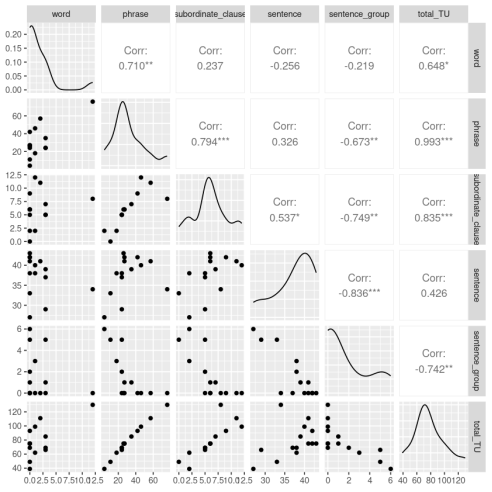
Figure 1. Independents multicollinearity.
Further quantitative analysis of the translation units segmented by participants reveals the presence of multicollinearity between different forms of translation units and the total number of translation units.
Figure 1 illustrates a strong positive correlation (r = 0.993) between the number of phrases and the total number of translation units. This indicates that if a participant is inclined to segment more phrases as translation units, the overall number of translation units tends to increase. Conversely, there is a strong negative correlation (-0.742) between the number of sentence groups and the total number of translation units. This suggests that participants who segment more sentence groups as translation units tend to have fewer total translation units.
Additionally,
Figure 1 illustrates the presence of linearity between different forms of translation units. A strong positive correlation (0.794) is observed between the number of subordinate clauses and the number of phrases, suggesting that participants who segment subordinate clauses as translation units are more likely to perceive phrases as translation units. Conversely, a strong negative correlation (-0.836) is evident between the number of sentences and the number of sentence groups. This suggests that participants who segment sentences as translation units are less inclined to segment sentence groups as translation units.
To preserve the validity of the linearity model between the number of translation units and participants’ interpreting performances and to mitigate collinearity among independent variables, the independent variables were standardized prior to their utilization in the ridge regression model
.
4.3. The Impact of Translation Units on Fidelity
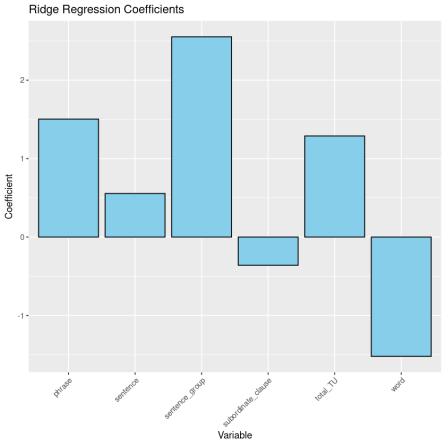
Quantitative analysis revealed the relationship between the pattern of translation unit segmentation and the aspect of fidelity in overall interpreting quality. The respective relationships between different linguistic forms of translation units and fidelity are shown in
Figure 2. The RRMSE of the ridge regression model was calculated to be 0.05, suggesting minimal discrepancies between the predicted and actual values of this model. This indicates the reliability and consistency of the model.
Figure 2. Ridge Coefficients between Translation Units and Fidelity.
In
Figure 2, it is evident that the linguistic form
word exhibits a strong negative coefficient with fidelity (-1.52), whereas
phrases,
total translation units, and
sentence groups are three independent variables with positive ridge regression coefficients above one, specifically at 1.50, 1.29, and 2.55, respectively, in relation to fidelity. This indicates that segmenting words as translation units could potentially compromise the fidelity of the interpreter’s performance compared to other linguistic forms. Conversely, the inclination to segment sentence groups as translation units appears to enhance the fidelity of interpreting performance, with the potential improvement expected to surpass that of other forms. Similarly, segmenting phrases as translation units is poised to enhance interpreting quality by bolstering fidelity. As was shown in Section 3.1, three subparameters of fidelity assessment were understanding, omission, and over-translation. The relationship between translation units and the interpreting performance’s fidelity demonstrates most directly how the pattern of segmenting text into translation units affected understanding, and ultimately affected overall interpreting quality.
Further retrospective interviews with participants revealed that segmenting sentence groups as translation units did not necessarily improve performance on fidelity. A possible explanation is that participants who exhibited a tendency to segment sentence groups as translation units were those more capable of understanding and deverbalizing the original speech within a limited time span, yet sentence groups could carry much information, other than the interpreter’s strategies to omit
| [15] | Gile, Daniel. 2009. Basic Concepts and Models for Interpreter and Translator Training. Amsterdam: John Benjamins Publishing Company. https://doi.org/10.1075/btl.8 |
[15]
, the deverbalized sense unit could be under-interpreted, leading to poorer performance on fidelity. A solution to that is segmenting phrases and sentences as translation units, thus ensuring that the sense of the original speech is accurately conveyed.
Source Text: “They do not deserve our tax dollars, they deserve our scrutiny; for the economy itself will die if our ecosystems collapse.”
Translation units E: They do not deserve our tax dollars; they deserve our scrutiny, for the economy itself will die if our ecosystems collapse./
Version E: Translation: Besides, we need to subject the polluting enterprises to higher scrutiny, because the environment is very important.
For example, in Participant E’s rendition, two sense units were lacking: it failed to express that enterprises lacked supervision rather than funds in response to climate change, and it did not reflect the consequences of the collapse of the ecological environment. Consequently, an under-interpreting phenomenon was observed in terms of fidelity. Participant E admitted that he should have segmented “for the economy itself will die if our ecosystems collapse,” as a single translation unit in order to avoid omitting sense.
It’s noteworthy that
Figure 2 illustrates a positive coefficient between the total number of translation units and the fidelity of interpreting performance. This suggests that fidelity could potentially be enhanced by segmenting the text into a more significant number of translation units. A possible explanation is that by segmenting the text into more translation units, with each translation unit being deverbalized into a sense unit, more sense units are retained in the reformulating stage. The more sense units reformulated in the target text, the more sense equivalence is achieved in the target text, thus ensuring higher performance in fidelity. However, considering the relationships between different linguistic forms of translation units and interpreting fidelity, where some are positive and others negative, it may be prudent to prioritize segmenting more sentence groups and phrases as translation units while avoiding excessive segmentation of words.
4.4. The Impact of Translation Units on Delivery
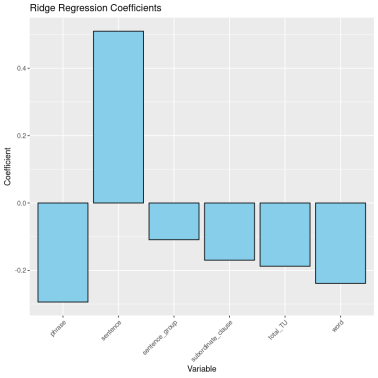
Below are the relationships between different linguistic forms of translation units and delivery. The RRMSE of the ridge regression model was 0.04, implying negligible disparities between the model’s predicted and actual values. This finding underscores the model’s reliability and consistency.
Figure 3 illustrates how the segmenting of translation units affected participants’ performance in terms of delivery. Sentence was the only linguistic form of translation unit that could enable positive improvement of delivery. Among four linguistic forms that may lead to the negative performance of delivery, including word, phrase, subordinate clause, and sentence group, phrases as translation units may have the worst impact on delivery, and sentence groups may have the least negative impact on delivery. We may infer from
Figure 3 that segmenting more sentences as translation units could improve delivery, whereas segmenting phrases as translation units may have a negative impact on delivery. The utilization of translation units in the form of sentences may result in minimizing cognitive load for interpreters, when they undertake the task of reformulating a given sentence into its equivalent form in the target language. This approach entails the least linguistic shift and consequently enhances performance in delivery.
Figure 3. Ridge Coefficients between Translation Units and Delivery.
The coefficient of variation of the original scores of delivery was 0.04, suggesting a close distribution of the original scores of delivery. Moreover, the total number of translation units had a negligible negative coefficient with the scores of delivery (-0.19). Considering both the closely distributed delivery scores of participants and the minimal coefficient observed between the total number of translation units and delivery scores, it can be inferred that the association between the number of translation units and delivery scores is insignificant. One plausible explanation for this observation is that the assessment criteria for delivery primarily focus on expressiveness and fluency, which are evaluated during the reformulating stage of the “understanding, deverbalizing, and reformulating” process within the framework of ITT. Since segmenting the text into translation units primarily impacts how these units are deverbalized into sense units during the understanding process, the direct relationship between translation units and delivery scores becomes less apparent.
4.5. The Impact of Translation Units on Language
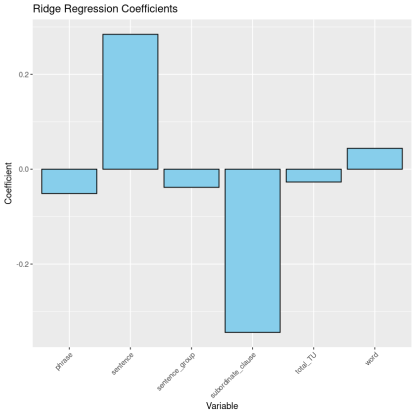
Figure 4 demonstrates the relationship between the segmentation of translation units and scores on language. The RRMSE of the ridge regression model was 0.03, which suggests that the ridge regression model was consistent and reliable.
In comparison to translation units in other linguistic forms, sentences exhibited the most significant positive coefficient with language (0.28), while subordinate clauses displayed the most substantial negative coefficient with language (-0.34). Other forms of translation units demonstrated moderately negligible coefficients concerning language scores. These coefficients suggest that segmenting more sentences as translation units is likely to result in higher language scores, whereas segmenting subordinate clauses may exert the most considerable negative influence on translation unit scores.
It is worth noting that the total count of translation units demonstrated a minimal negative coefficient with language scores (-0.02), which was the smallest among all coefficients. This observation suggests that the overall number of translation units has scarcely any discernible relationship with language scores. One possible explanation for this phenomenon is that the subcategories comprising language quality assessment encompass grammar, semantics, and lexical selection, which constituted the evaluation criteria during the reformulation stage of the interpreting process. Since the segmentation of translation units occurred at the understanding stage, which precedes the deverbalizing and reformulating stages, its impact was more salient during the understanding phase, as elaborated in Section 4.3.
Figure 4. Ridge Coefficients between Translation Units and Language.
4.6. The Impact of Translation Units on Time
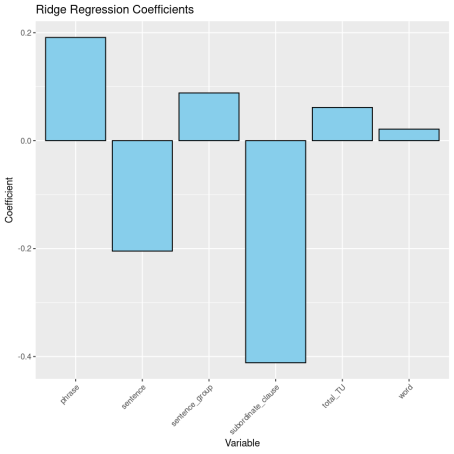
Figure 5 demonstrates the relationship between the segmentation of translation units and scores on time. The RRMSE of the ridge regression model was -1.86, higher than any other assessment criterion, surpassing that of any other assessment criterion. This indicates that the ridge regression model lacked the accuracy and consistency displayed in other regression models, and a significant relationship between translation units and performance regarding timeliness was not observed. One plausible explanation is that the duration of interpreting is directly influenced by the quality of delivery; reduced disfluency and enhanced expressiveness contribute to ensuring efficient and timely interpretation. Given the insignificant relationship observed between translation units and delivery, as discussed in Section 4.4, it follows that the association between translation units and performance in terms of timeliness is similarly insignificant.
The coefficients derived from the ridge regression model can also serve as indicators of how the segmentation of translation units influences interpreting performance in terms of timeliness. As illustrated in
Figure 5, subordinate clauses exhibit the most substantial negative coefficient with time scores, while phrases display the most prominent positive coefficient with time scores. Given that the assessment criteria for timeliness evaluate whether the interpreting time is shorter than the original speech or exceeds 120% of the original speech duration, this regression model suggests that segmenting more phrases as translation units could contribute to time savings, whereas segmenting subordinate clauses as translation units may have the opposite effect.
Figure 5. Ridge Coefficients between Translation Units and Time.
4.7. The Impact of Translation Units on the Total Score of Interpreting Performance
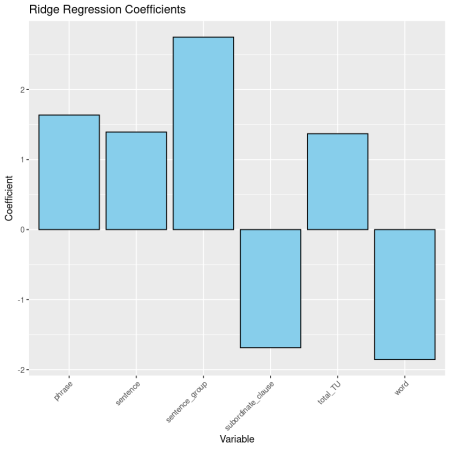
Figure 6 shows the relationship between translation units and the total scores of interpreting. The RRMSE of the ridge regression model was 0.04, which indicated negligible differences between predicted values and actual values. The findings underscore the reliability and accuracy of the ridge regression model.
Figure 6. Ridge Coefficients between Translation Units and Total Interpreting Score.
In
Figure 6, it is evident that the number of sentence groups displayed the most substantial positive coefficient with the total score of interpreting performance (2.74), followed by the number of phrases as translation units (1.64) and the number of sentences as translation units (1.39). Moreover, the total count of translation units also exhibited a positive coefficient with the overall score of interpreting performance (1.37). Conversely, the number of subordinate clauses demonstrated a negative coefficient with the total interpreting quality (-1.69), while the number of words exhibited the most significant negative coefficient with the total interpreting quality (-1.86). From these coefficients, it can be inferred that segmenting the text into more translation units could lead to an improvement in interpreting quality. Specifically, segmenting sentence groups as translation units appears to have the most pronounced positive impact on interpreting performance quality. Additionally, segmenting phrases and sentences as translation units could also contribute to enhancing interpreting quality. Conversely, segmenting subordinate clauses is likely to adversely affect interpreting performance, and an excessive segmentation of words is associated with the lowest interpreting quality.
We posit that segmenting sentence groups as translation units yields the most favorable outcomes in enhancing the total score of interpreting performance. This assertion stems from the notion that sentence groups provide interpreters with optimal opportunities to deverbalize translation units into sense units and subsequently reformulate them into the target language “as if they were their own”
| [1] | Lederer, Marianne. 2010. Interpretive approach. In Handbook of Translation Studies, Volume 1, edited by Yves Gambier and Luc van Doorslaer, 173-179. John Benjamins Publishing Company. https://doi.org/10.1075/hts.1.int3 |
[1]
. Given that sentence groups represent the highest level of linguistic organization among translation units, sense units derived from them can be reformulated with the greatest freedom, without being constrained by the specific organization of neighboring translation units. In contrast, the tendency to segment words as translation units exerts the most detrimental impact on overall interpreting performance. This is because interpreters may overly prioritize literal meaning and formal equivalence in the target language, rather than effectively conveying the intended sense of the speaker while preserving the style and register of the discourse in the target language. Moreover, such segmentation may compromise the logical hierarchy within the text and diminish its coherence, thereby ultimately undermining the interpreting quality. For example, the segmentation and rendition of participants were analyzed, upon which retrospective interviews were conducted:
Source Text: “As if pretending that climate change wasn’t real would somehow make it go away. But I think we all know better than that now.”
Translation units F: As if pretending / that climate change wasn’t real/ would somehow make it go away./ But I think/ we all know better than that/ now./
Version F: Translation: However, they pretend that climate change does not exist.
Translation units G: As if pretending that climate change wasn’t real would somehow make it go away./ But I think we all know better than that now./
Version G: Translation: Thinking that if we pretend they are not real, they will disappear naturally. But in reality we have seen more.
In comparison to Participant G, Participant F segmented translation units encompassing words, phrases, subordinate clauses, and sentences. Participant F asserted that each translation unit could convey meaning. However, upon closer examination, it was noted that the final sentence was segmented into a phrase, a subordinate sentence, and a word, yet none of these components were presented in his rendition. Consequently, this discrepancy inevitably resulted in a decrease in fidelity to the original speech. Upon reflection, Participant F conceded that he had overly focused on comprehending the original speech, which led to a failure to take adequate notes and ultimately hindered his ability to accurately reproduce the intended meaning during interpretation. This incident may serve as another piece of evidence that segmenting translation units at lower linguistic levels could potentially impede the understanding process, thereby resulting in diminished interpreting quality.
Drawing upon the insights from this section and those presented in Section 4.3, it becomes evident that similar recommendations for performance enhancement emerge. Specifically, segmenting more sentence groups and phrases as translation units is likely to positively impact interpreting quality, while segmenting words as translation units may potentially have a negative effect on overall interpreting quality. It is noteworthy that the positive and negative coefficients observed in the ridge regression model in this section are more pronounced compared to those in Section 4.3, indicating a heightened influence of translation units on overall interpreting quality as opposed to fidelity. As explained in Section 4.3, the segmentation of translation units serves as external evidence of the interpreter’s understanding of the source speech, which in turn determines the conveyed sense. Consequently, a significant relationship between translation units and fidelity—denoting the accuracy with which the sense of the source speech is conveyed in the target speech—is discernible. In other words, participants who scored higher on fidelity demonstrated a superior ability to understand and deverbalize, thereby tending to receive higher ratings on overall interpreting performance.





 Share This Article
 Twitter
 Linked In
 Facebook
 Copy
Copy Download